
📋 Key points
Myopia management: what Sydney parents need to know
Myopia affects about 30% of children in Australia and can progress rapidly.
Every set of eyes are unique; treatments need to be personalised to your child’s needs.
We measure eye growth in millimetres with an optical biometer.
Nothing is set in stone: we adjust follow-ups and treatments and more as your child grow.
We work together: the team, optometrists and your family in the process.
Most parents don’t realise that short-sightedness in children can sometimes progress quickly as they grow. Around 30-40% of Australian children suffer from myopia and many are diagnosed by the age of 12. This number might sound high but it’s consistent with modern data trends across the world.
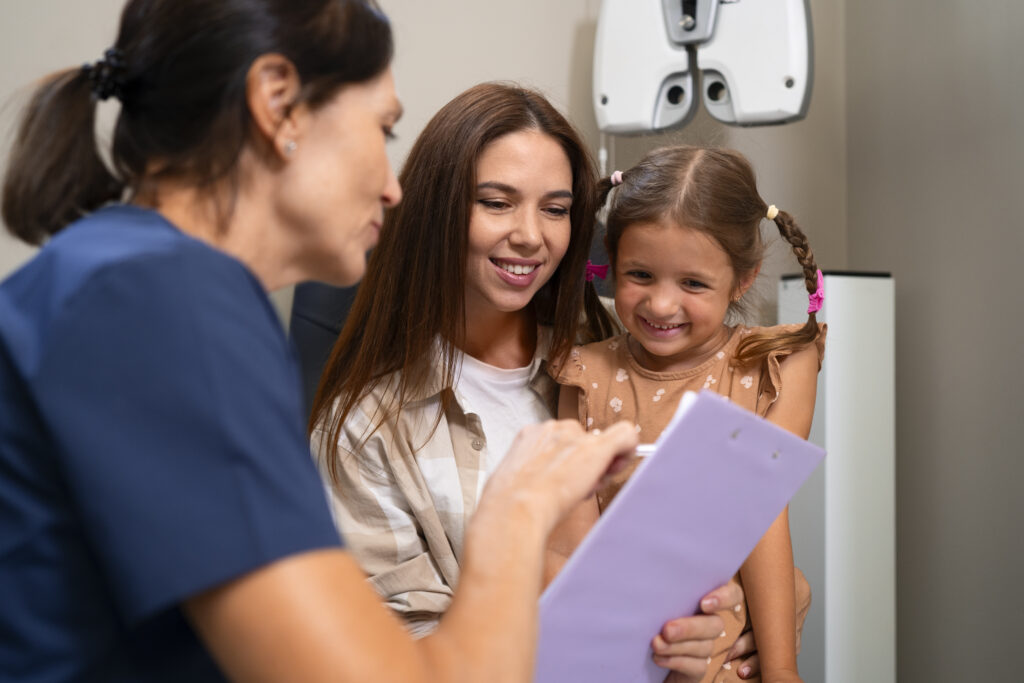
What is myopia management?
Myopia (or short sightedness) happens when a child’s eye grows too long. Light falls short of the retina, making distant objects blurry. The problem isn’t just the blurring; it’s that the eye can keep growing, increasing the prescription and the long-term risks to eye health.
Myopia management is about slowing that progression down. Corrective glasses or standard contact lenses help children see clearly, but they don’t prevent the prescription from worsening.
As each child’s eye is unique
Options depend on your child’s prescription, lifestyle, and visual demands, but commonly available evidence-based interventions include:
- MiYOSMART lenses – Spectacle lenses designed to slow eye growth.
- Low-dose atropine drops – eye drops applied at night to slow eye elongation.
- Ortho-k (Orthokeratology) – overnight lenses that temporarily reshape the cornea.
- Repeated low-level red-light (RLRL) therapy – light-based home device treatment.
The right combination depends on your child’s age, presentation, lifestyle, and how quickly their eyes are growing.
What about children who aren’t myopic yet?
If your child is showing signs of being at risk (e.g. one or both parents are short-sighted, the anatomy of the eye shows early axial elongation, or lifestyle factors like excessive screen time and low outdoor activity are present), we can discuss preventive strategies. Encouraging outdoor time, regular breaks from near work, and monitoring the eye can help delay myopia onset. The earlier we intervene and monitor, the more significant difference we can make.
Measuring eye growth in millimetres
One of the most valuable tools in our practice is the optical biometer. This piece of equipment measures the physical length of your child’s eyes in millimetres. This is called axial elongation, specifically in growing eyes.
We measure axial length because children’s eyes naturally grow, but in myopia, they grow too fast. By measuring axial length at each visit, we can clearly see if a treatment is working or if the eye is continuing to grow too rapidly, rather than simply relying on prescription changes alone.
We use advanced technology like the DVI Myopia Calculator and biometry to help detect changes in these measurements. This accurate monitoring allows us to make timely and well-informed adjustments.
💡 What happens during a consultation
1. Initial discussion
Detailed history taking, visual needs review, and lifestyle assessment.
2. Vision and eye testing
Comprehensive testing of vision, refraction, eye muscle coordination, and binocularity.
3. Optical biometry and ocular health
Precise axial length measurements and comprehensive eye health screening.
4. Customised treatment plan
Tailored recommendations and next steps for slowing down progression.
The whole visual system matters
Eye consultations go beyond simply finding a prescription. We assess binocularity and accommodation, evaluating how well both eyes function together and focus at near distances.
Checking all elements ensures nothing is missed, helping your child succeed both academically and visually.
📅 When should you book?
Don’t wait until your child develops noticeable vision problems. If there’s a family history of myopia, your child squints, struggles to see the board at school, or spends long periods reading or using screens, now is the right time to book a comprehensive eye examination.